
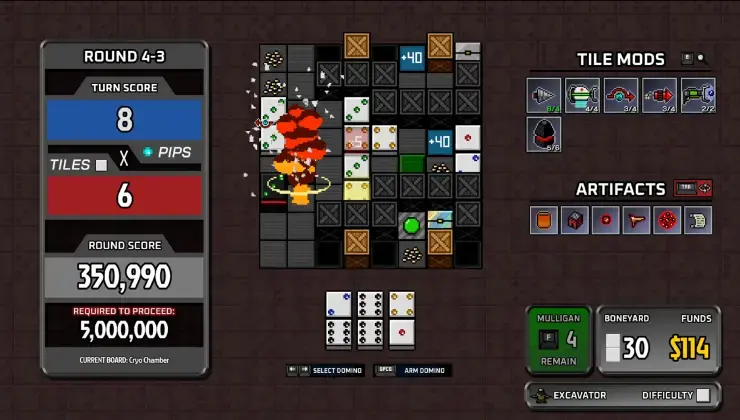
The puzzle roguelike genre continues to evolve with innovative new entries, and Dominocalypse has emerged as one of the most intriguing additions to the scene. Taking clear inspiration from the wildly successful Balatro and other score-chasing roguelikes that have captivated players in recent years, this new title puts a unique spin on the formula by incorporating dominoes as its core mechanic. The result is a fresh and clever approach that manages to stand out in an increasingly crowded market of deck-building and puzzle-based roguelikes.
The roguelike genre has experienced a remarkable renaissance over the past decade, with developers finding creative ways to blend traditional roguelike elements with other gaming genres. From deck-builders like Slay the Spire to the poker-inspired mechanics of Balatro, these hybrid games have proven incredibly popular among players who enjoy strategic thinking and the thrill of procedurally generated runs. Dominocalypse enters this space with dominoes serving as the primary gameplay element, offering a tactile and visually distinct experience that sets it apart from its card-based contemporaries.
A Fresh Take on Score-Chasing Mechanics
What makes Dominocalypse particularly compelling is how it translates the familiar rules of dominoes into roguelike progression systems. Players must carefully consider the pip values on each domino, creating chains and combinations that multiply scores in satisfying ways. The game introduces various modifiers, power-ups, and special dominoes that can dramatically alter gameplay strategies, much like how Balatro introduced jokers and special cards to transform traditional poker hands into something entirely new and exciting.
The domino mechanic opens up interesting strategic possibilities that differ significantly from card-based alternatives. Unlike cards, dominoes have values on both ends, creating a dual-consideration puzzle where players must think about both immediate placement and future possibilities. This added layer of complexity rewards careful planning while still maintaining the accessible pick-up-and-play nature that makes roguelikes so appealing to a broad audience. The visual satisfaction of watching domino chains form and cascade adds an almost meditative quality to the gameplay experience.
Building on the Roguelike Renaissance
The success of games like Balatro, which became a breakout hit and cultural phenomenon, has demonstrated that there is significant appetite for innovative takes on classic game concepts within the roguelike framework. Balatro’s achievement in making poker exciting for players who had never touched a deck of cards showed that familiar mechanics, when reimagined through roguelike systems, could reach entirely new audiences. Dominocalypse appears to be following this playbook, taking dominoes—a game with centuries of history dating back to 12th-century China—and reinventing it for modern gaming sensibilities.
The puzzle roguelike subgenre has become a proving ground for indie developers looking to make their mark. These games typically feature shorter run times than traditional roguelikes, making them perfect for both quick gaming sessions and longer marathon plays. The combination of luck-based elements with skill-based decision making creates a compelling loop where players constantly feel they are improving, even when runs end in failure. Dominocalypse embraces these principles while carving out its own identity through its distinctive domino-based mechanics.
Looking Ahead for Puzzle Roguelikes
As the gaming community continues to embrace innovative indie titles, Dominocalypse represents the ongoing evolution of what puzzle roguelikes can be. The game demonstrates that there is still plenty of room for creativity in a genre that some might have considered fully explored. By looking to traditional tabletop games for inspiration, developers are finding fresh wellsprings of gameplay possibilities that resonate with both nostalgic players and newcomers alike. The success or failure of Dominocalypse could influence future developers to explore other classic games as foundations for their roguelike experiments, potentially leading to a new wave of innovative hybrid titles that continue to push the boundaries of the genre.
Expert Opinion: The puzzle roguelike space is reaching a maturation point where derivative entries will struggle, but truly innovative concepts like Dominocalypse’s domino mechanics can still break through. We anticipate this trend of mining traditional tabletop games for roguelike inspiration will accelerate, with dominoes, mahjong, and other classic games likely becoming the next frontier for indie developers seeking fresh gameplay hooks.